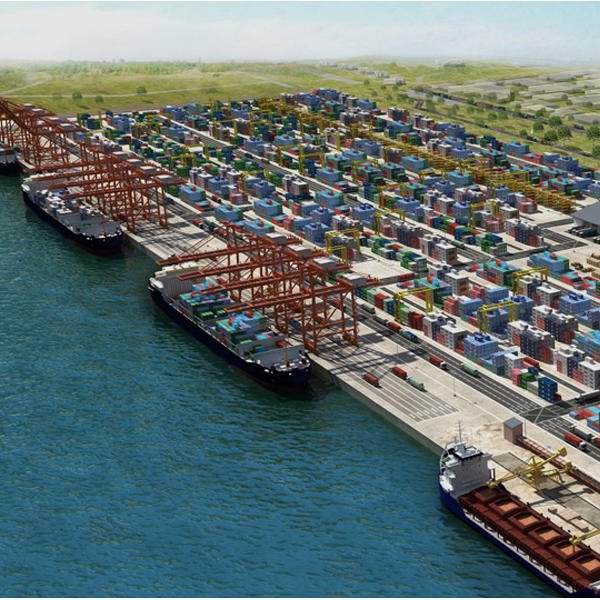
Lekki Deep Sea Port can already demonstrate what the asset itself is capable of doing.
The port can receive some of the largest container vessels calling in West Africa, has developed a growing transshipment business and recorded the fastest cargo-throughput growth among Nigerian ports in the Nigerian Ports Authority's 2024 consolidated results. NPA also reported an average vessel turnaround time of 2.5 days at Lekki that year, the best across the port system.
Those are useful operating results. They tell us that the terminal works.
They do not settle the economics of everything that happens after cargo crosses the quay.
A container still has to be cleared, collected, and moved to a factory, warehouse, market, or another port. The organisations responsible for those steps are not all contained within the port company, and the investments that support them do not all sit inside the port's own capital programme.
Nigeria is developing a 24.9-kilometre 7th Axial Road intended to connect the Lekki Port area to the wider regional and national highway system. Rail connectivity to the port is also being planned separately. The terminal can therefore grow while parts of the wider freight system around it continue to develop on different institutional and investment timetables.
The question I would ask at that point is not whether the port is complete.
It is which assumptions about its future use now depend on something outside it.
Where the financial model stops
Every infrastructure project needs a boundary.
An approval paper needs to state what is being financed. Engineers need a scope. Contractors need defined obligations. Lenders need to know which revenues, costs and risks belong inside the transaction. Somebody must ultimately be accountable for delivery.
The economic life of the asset is usually wider than that boundary.
A port's construction scope can end at its gates while freight continues hundreds of kilometres inland. A railway can be operational while passengers still depend on buses and minibuses to reach its stations. A developer can finish a house before a buyer has the title, equity and mortgage needed to acquire it.
This creates a recurring problem in infrastructure appraisal.
The model may contain a cargo forecast, ridership forecast or housing-demand assumption whose outcome depends partly on investments and decisions that the sponsor does not control directly.
Some of those dependencies exist from the first day of operation. Others matter only when utilisation reaches a certain scale. Some develop in response to the asset itself.
That difference is easy to lose when every external issue is placed into the same risk register.
I would want to know something more precise: which assumption changes, who controls the variable behind it, and when does that variable become material to the economics of the asset?

Lekki's road and rail connections illustrate why timing matters.
The absence of an operational rail connection has not prevented the port from handling significant cargo volumes. That makes it difficult to argue that rail was a precondition for the first phase of utilisation. Its importance may grow as the scale and geographic reach of freight movements increase.
Road access presents a different case. Cargo leaving the terminal already depends heavily on the surrounding road system, while additional corridor capacity is still being developed.
The distinction matters.
An external dependency can constrain an asset from opening. It can also become material much later, when a successful asset begins asking more of the system around it.

The surrounding system can respond to the asset
Urban rail creates another version of the same problem.
Lagos's Blue Line has carried more than nine million passengers across over 70,000 trips since commercial operations began in September 2023. By September 2026, LAMATA reported approximately 94 daily trips, up from 12 at launch, with ten-minute peak headways and operational reliability of about 99.5 per cent.
Those numbers describe what the railway operator controls reasonably well: trains, frequency and reliability.
A passenger's journey contains more than the train ride.
Someone travelling from an area beyond walking distance of a station still needs to get there. The usefulness of the line therefore depends partly on the surrounding transport network, including operators who sit outside the formal rail system.
Recent evidence from Lagos makes that relationship unusually visible.
Researchers working through the International Growth Centre examined the city's minibus network before and after the Blue Line entered operation. Minibus routes feeding Blue Line stations expanded, and departures on feeder routes that remained in operation increased by about 33 per cent. Routes competing more directly with the railway were more likely to close.
The finding matters because the complementary transport system did not simply exist in a finished state before the railway opened.
Part of it adapted afterwards.
The arrival of rail changed the economics of other routes. Some minibuses became more useful because they connected passengers to stations. Others faced a stronger substitute.
The relationship therefore runs in both directions. The surrounding network affects how passengers reach rail, while the presence of rail changes how parts of that network organise themselves.
That is a different planning problem from building an access road to a port.
The sponsor can model feeder demand before opening. It cannot dictate every commercial decision that thousands of independent transport operators will make after the relative value of routes changes.
Formal interchange infrastructure adds another layer. LAMATA is still developing interchange facilities around the network as it expands its integrated transport system. These are dependencies beyond the rail tracks themselves, but they sit much closer to the authority's capacity to coordinate and deliver.
That gives us at least three different forms of control within one transport system.
The operator can directly determine train frequency. The public authority can coordinate interchange infrastructure. Independent transport operators and passengers make decisions that the authority can influence but cannot command.
An appraisal that groups all three together under "integration risk" would hide the distinction that matters most.
Housing moves the problem into the transaction
The same question becomes less physical in housing.
A house may be complete and still remain outside the transaction through which an eligible buyer can acquire it.
Nigeria's Ministry of Finance Incorporated Real Estate Investment Fund, MREIF, was designed partly around that gap. The programme provides long-term mortgages and also supports housing supply through conditional offtake guarantees for developers. Current mortgage terms offer financing at a fixed 9.75 per cent for up to 20 years, with the minimum equity contribution reduced to 10 per cent.
The important part is the chain between capital and the completed home.
Agusto & Co.'s 2026 rating report on MREIF found that mortgage deployment during the period to December 2025 was being affected by property-title documentation, delays and costs around registration, the availability of housing at affordable price points and the capacity of parts of the mortgage-banking system. The fund consequently held a substantial portion of its portfolio in liquid assets while mortgage uptake developed.
Capital was available.
Housing demand also existed.
The ability to connect one to the other still depended on several additional conditions.
A qualifying property needs documentation that can support a mortgage. The buyer needs sufficient income and equity. A participating financial institution needs the balance-sheet and operational capacity to originate the loan. The terms of the mortgage must then produce a monthly obligation the household can carry.
Construction solves only part of that sequence.
This is why aggregate statements about "housing demand" are often insufficient for an investment decision. Demand becomes economically useful to a financing programme when it can be converted into a transaction.
The distinction also prevents us from treating constraints as permanent.
MREIF itself has continued to expand mortgage deployment as more financial institutions participate and the programme develops. The relevant question is therefore not whether the surrounding system is either ready or unready. It is where the transaction is currently losing eligible properties or buyers, and whether those constraints are improving quickly enough to support the assumptions in the programme.

Three assets, three different dependencies
Ports, urban rail and housing are different enough that forcing them into one template would make the analysis weaker.
Lekki shows a dependency whose importance can increase as the asset scales.
The Blue Line shows a surrounding market reorganising in response to a new asset.
Housing shows an institutional and financial chain through which physical supply has to become a workable transaction.
The common problem sits somewhere deeper.
Each investment creates technical capacity inside a defined project. Realised utilisation may then depend on conditions distributed across other institutions, infrastructure owners, businesses and users.
Those conditions also sit at different distances from the sponsor's control.
I find it useful to separate them into four broad categories.
Some variables are directly controlled. Train frequency, terminal operations and mortgage-product terms sit reasonably close to the organisation responsible for the asset or programme.
Others require coordination. An interchange, access road or title process may depend on another public body or delivery programme whose decisions can be aligned but are not identical to the core asset.
A third group can be influenced without being commanded. Financial intermediaries, logistics operators and private transport services can respond to incentives, contracts and demand.
The final group consists of autonomous market responses. A shipping line chooses a route. A commuter changes modes. A household decides whether the mortgage is affordable enough to take on.
That distribution of control should matter to the investment case.
The more important an assumption is to expected utilisation, and the farther the controlling decision sits from the sponsor, the more carefully I would want that assumption tested.
What I would want to see before approval
A systems map becomes useful when it changes a decision.
I would not want a board paper containing twenty boxes around an asset simply to demonstrate that infrastructure is complicated. Complexity is already available in generous quantities.
I would want the analysis to identify the few external dependencies capable of materially changing the utilisation case.
For each one, four questions matter.
What assumption changes?
If the dependency performs below expectation, does the effect appear in throughput, ridership, mortgage origination, operating cost, revenue or the timing of benefits?
Who controls the outcome?
The answer may be the sponsor, another public institution, a contracted counterparty, an independent market participant or nobody in particular.
When must it work?
Some dependencies are required at opening. Others become important only as utilisation grows. Some, as the Lagos minibus evidence suggests, develop after operations begin.
How sensitive is the case?
The investment paper should show what happens when the assumption moves. A dependency that reduces expected utilisation by two per cent belongs in a different conversation from one capable of cutting it by thirty.

These questions also improve the usefulness of a conventional risk register.
A risk register asks what could prevent the project from being delivered as planned.
The systems analysis asks what could leave a successfully delivered project used differently from plan.
The distinction is particularly important once construction is no longer the largest source of uncertainty.
A technically complete asset can begin producing real operating evidence. Forecast behaviour becomes observed behaviour. Assumed interfaces become actual ones. A dependency that looked minor at approval can start consuming management attention, while another that attracted significant concern may prove manageable.
That is why this analysis should continue after commissioning.
Completion changes the evidence
The investment case is strongest when it can distinguish what the sponsor knows from what it expects other actors to do.
Before Lekki opened, traffic forecasts could estimate how shipping lines and cargo owners might respond. Operation now provides evidence about vessel calls, throughput and the pressure placed on surrounding transport systems.
Before the Blue Line opened, planners could model how passengers and existing transport operators might react. Three years of operation now show parts of the minibus market reorganising around the railway.
Before mortgage capital is deployed, a housing programme can estimate eligible demand. Actual origination exposes the properties, borrowers and institutions capable of completing the transaction.
Infrastructure therefore reveals another set of questions after it begins to work.
For me, that is the practical value of looking beyond the asset.
It does not require making one project sponsor responsible for roads, banks, commuters, shipping companies and half the economy.
It requires being explicit about which assumptions in the case depend on them.
When those dependencies are material, I would want their ownership, timing and sensitivity visible before capital is committed.
When the asset begins operating, I would want those assumptions revisited against actual behaviour.
The project boundary tells us what we have agreed to build.
The investment case should also tell us what has to happen around it for that capacity to be used as expected.